

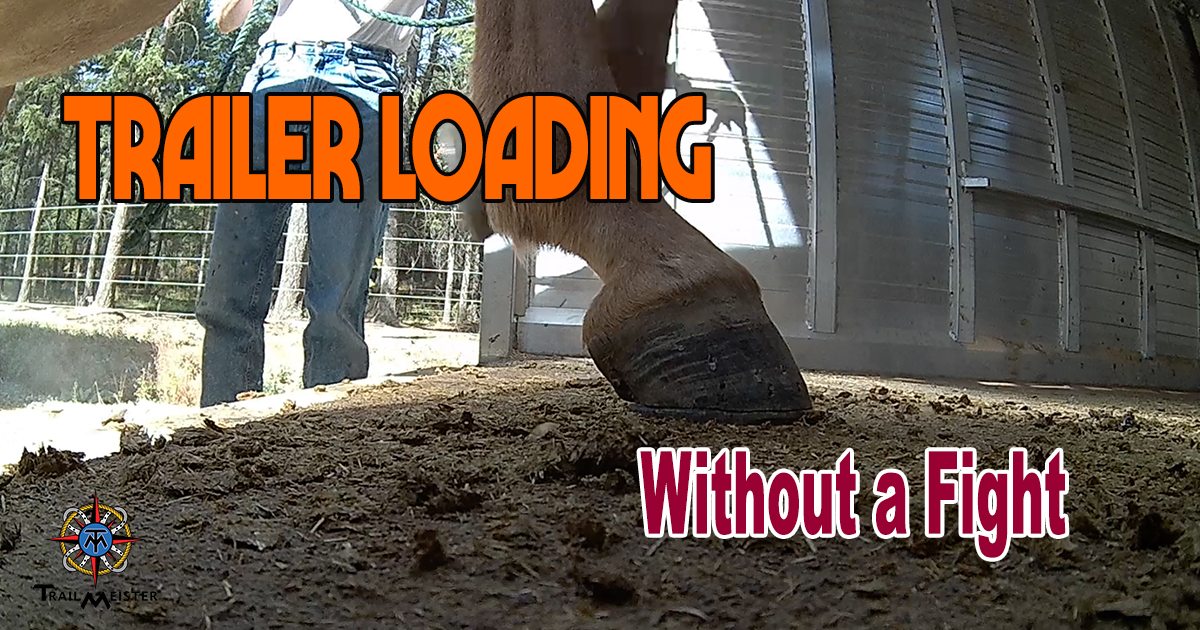
Trailer Loading. If you’re going to trail ride or horse camp, sooner or later you’re going to have to put your horse in a trailer. And, more importantly, you’re going to have to get him back in again when it’s time to come home. A horse that loads willingly makes every trip easier. One that refuses can stop the ride before you leave the house or leave you stuck at the trailhead after a long day.
I’ve been on both ends of that equation and I know the feeling. Once it happened to me after a four-day clinic with Ty Evans. Nothing keeps a person humble like spending four days improving your horsemanship and then having an animal that won’t get in the trailer. It’s frustrating, embarrassing, and probably more common than most horse people care to admit.
Why Horses Don’t Want to Load
From the horse’s point of view, refusing to enter a trailer makes sense. We’re asking a prey animal to walk into a dark metal box that rattles, smells funny, and has a floor that sounds and feels different under his feet. Then we close the door and bounce down the road. What we call stubbornness may simply be self-preservation.
Despite what the latest social-media horse guru may promise, reliable trailer loading isn’t something I expect to teach in fifteen minutes. Yes, you might be able to force a horse into a trailer but getting him inside and teaching him to load are two different things. I’m less interested in getting the horse in the trailer today than I am in having one that’ll load easily tomorrow, at a busy trailhead, or when something has gone wrong and I need to get him somewhere in a hurry. The recent firestorm here in Spokane was a warning for all of us. An evacuation order is not the time to discover your horse has decided he’s not getting into the trailer.
Trailer Loading Starts on the Ground
For me, trailer loading starts with being able to control the horse’s feet. In many ways, trailer loading is simply another test of whether I can direct those feet where I want them to go. Before asking a horse to enter a confined space, I want him to move forward from a light ask, yield his shoulders and hindquarters, back quietly, and pay attention to me. If I can’t direct his feet in an open area, I’m probably not going to do it better at the back of a trailer.
Make the Trailer the Easy Place
Once those basics are in place, I use something horses understand very well: conserving energy. Away from the trailer is where we work, and near the trailer is where we rest. With the trailer securely hitched and the doors and dividers safely positioned, I’ll work the horse in a small circle behind it. I use a lead rope rather than a longe line so I can keep him reasonably close and under control. Then we stop near the trailer.
At first, “near” might mean several feet away, and that’s fine. As the horse relaxes, our resting spot gets closer. If he stretches his neck toward the doorway, sniffs the floor, or sticks his head inside, I let him investigate. I’m watching for curiosity to begin replacing fear. When his attention wanders, we go back to work for a while, then return to the trailer and rest. Horses are pretty good at figuring out that arrangement.
Reward the Try
When he’s ready, I’ll ask for a step toward the trailer, and the instant he tries, the pressure goes away. Maybe he only gives me one step or puts his front feet inside and stops. That’s fine. I’ll let him stand and think before asking again. If he doesn’t respond, I’ll gradually increase the pressure until he tries, then release immediately. That well-timed release is how I tell him, “Yep, that’s what I wanted.”
A common mistake happens when the horse finally puts a foot or two inside and we get greedy. We think, “Great! Let’s get the rest of him in there before he changes his mind!” Instead of rewarding the try, we increase the pressure. From the horse’s point of view, he just did what we asked, and his reward was having things get harder. That’s not the lesson I want to teach.
Instead, I build the lesson one step at a time. I’ll let him walk partway in and back out before he feels trapped, then we’ll try again. As he becomes comfortable, I’ll ask him to go farther and stand longer. Once he’s loading comfortably, I may take him out, move his feet for a short time, then ask him to load again and rest. In time, the trailer becomes the easy place.
Practice Before You Need It
Practice when you don’t need to go anywhere and you’ve got all day to get there. The morning you’re meeting friends at the trailhead isn’t the time to discover you have a loading problem. Practice at different times and in different weather, and sometimes load the horse, let him stand quietly, and unload without going anywhere. Not every trip into the trailer needs to end with a trip down the highway.
Getting Out Matters Too
Don’t forget about unloading either. I don’t want an animal rushing out of a trailer any more than I want one refusing to go in. Mine learn to wait until I ask them to come out quietly. And through all of this, safety comes first. Never wrap a lead rope around your hand, put yourself where you can be crushed, or stand directly behind an animal that may rush backward.
Trailer loading doesn’t need to be a fight. Good ground control, small requests, a well-timed release, and enough patience to let the horse think will accomplish a lot more than trying to win an argument with a thousand-pound animal. Getting him in once isn’t much of a victory if I have to fight the same battle tomorrow. I want the trailer to become just another place I can quietly ask my horse to put his feet, whether we’re standing in the driveway or tired and ready to head home after a long day on the trail.
For more of my thoughts on trail riding and horse camping, as well as the world’s largest guide to horse trails and camps, visit TrailMeister.com. You can also find my books on Amazon.