What Teaching Mohair Cinch Weaving Has Taught Me About Being a Beginner
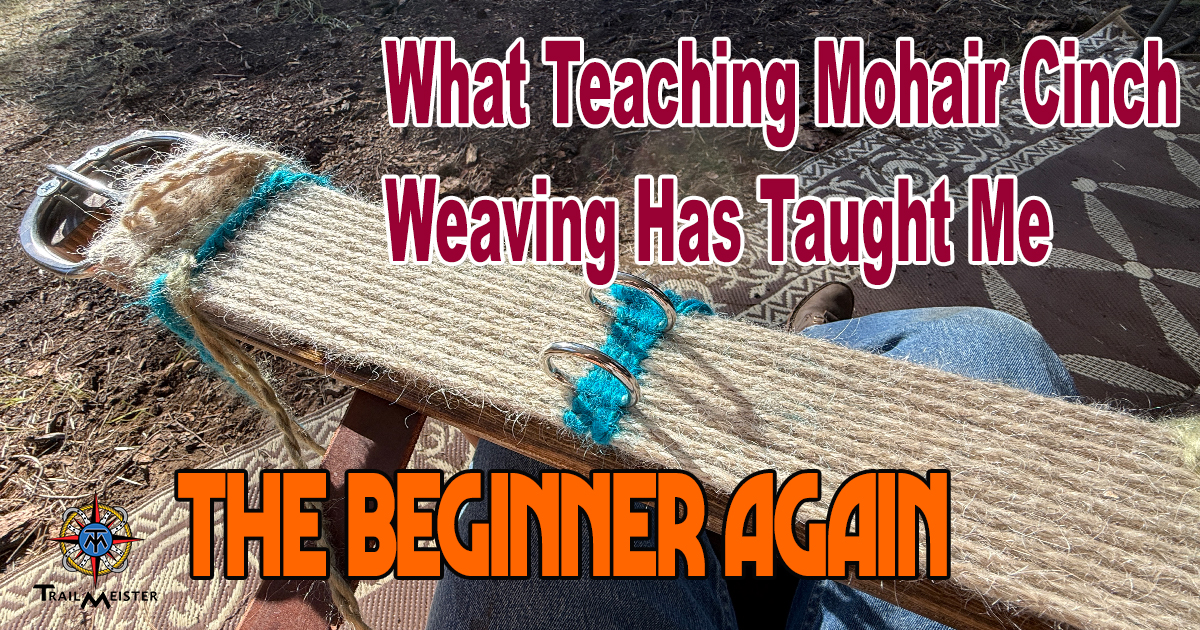
Every mohair cinch clinic starts the same. People arrive carrying all sorts of life experiences. I’ve had doctors, engineers, attorneys, and people with more degrees than I can count sit down at the looms. They’re smart people who’ve spent their lives becoming very good at difficult things. Then I hand them a hank of mohair, and suddenly, we’re all beginners again.
To be fair, some people have a natural knack. Their hands seem to understand fiber and knots more quickly than others. I wasn’t one of those people. But after teaching a lot of people, I’ve become convinced there’s only one way to get good at making cinches. You have to make a lot of cinches.
My mentor, Ed Haefliger, used to say, “You need to build more cinches.” It’s simple advice, but it isn’t always easy to accept. People who are used to being good at things often become frustrated when their first diamond pattern looks no better than the one woven by the person sitting next to them. Sometimes it looks worse. They’re used to competence following them through life and expect it to show up at the loom as well. Unfortunately, mohair isn’t impressed by your résumé. The loom doesn’t care what letters appear after your name. The knots ask the same question of everyone: Are you willing to be a beginner?
When someone gets frustrated, I usually start asking questions. Did you mark the center? Did you follow the sequence we just practiced? The end product usually tells the truth. A step was skipped. Something wasn’t done quite the way it was demonstrated.
How someone responds to that moment often determines whether they’re willing to learn. You can’t buy a new tool to get yourself out of those weeds. You can’t say, “But I have a PhD,” and have the knots suddenly behave differently.
At some point, every beginner has to admit something uncomfortable. “I stink at this.” Fortunately, being bad at something is the first step toward becoming good at it.
Some Things Have to Be Uploaded Through Your Fingers
Books help. That’s one reason I wrote It’s a Cinch!. A book can show you where your hands belong and explain how a knot is formed. But sooner or later, the words have to leave the page and become movement. I’ve had students struggle through a knot until I reached over, took their hands, and guided them through it. The moment they felt the knot come together, something clicked. That kind of teaching can be uncomfortable because it requires accomplished people to stop being the one with the answers and become the one asking the questions.
Some things simply can’t be downloaded. Your fingers have to learn them.
The way forward is, I’m afraid, to go full Buddhism and set down your sense of self for a while. Become the child on the first day of school. Tie the knot this way. Hold the cord this way. Try again. Little by little, your hands stop thinking about the movements and start remembering them. The knots become familiar. One day you realize you aren’t following instructions anymore.
You’re weaving.
Learning to Feel Instead of Knowing
I’ve changed the way I teach because of this. Somewhere along the line I realized people weren’t struggling because they lacked information. They were struggling because they hadn’t yet developed the feel. I used to think my job was to give people as much information as possible. I wanted to tell them everything I knew about looms, knots, mohair, mules, and the history behind all of it. Now I know a little better. The books, magazines, YouTube videos, and internet rabbit holes are largely self-directed. At the loom, students usually do well with remarkably little instruction. “Watch this.” “Try again.” “May I make a suggestion?” “That’s it.”
I’m happy to talk about the finer points of weaving around a campfire, and I very much enjoy those conversations. But at the loom, sometimes words become obstacles. Words are clumsy tools for describing something your hands need to feel.
Eventually, there comes a point where there’s nothing left for words to explain. You simply have to weave another row, tie another knot, and build another cinch.
And maybe that’s one of the great gifts of learning. Whether we’re weaving a cinch, trying to understand a mule, or simply trying to grow into a better version of ourselves, it occasionally invites us to become children again. To listen carefully, to follow directions, and to make mistakes without embarrassment. To be beginners. And to discover that competence still grows the same way it always has. Little by little, one repetition at a time.
For more thoughts on trail riding, horse camping, and caring for the horses and mules that carry us into wild places, visit www.TrailMeister.com, home to the world’s largest guide to horse trails and camps. You can also find my books on Amazon.