A mule that won’t load in the trailer. A flat tire alongside the road. A box of tools wandering somewhere through the postal system between Spokane and Tennessee. A summer when the doctor says riding the mules is off the table. None of those things would make my list of preferred activities, but I’m beginning to think what happens next matters more than what went wrong in the first place.
The eighth-century Indian Buddhist monk and scholar Shantideva put it this way: “Why be unhappy about something if it can be remedied? And what is the use of being unhappy about something if it cannot be remedied?”
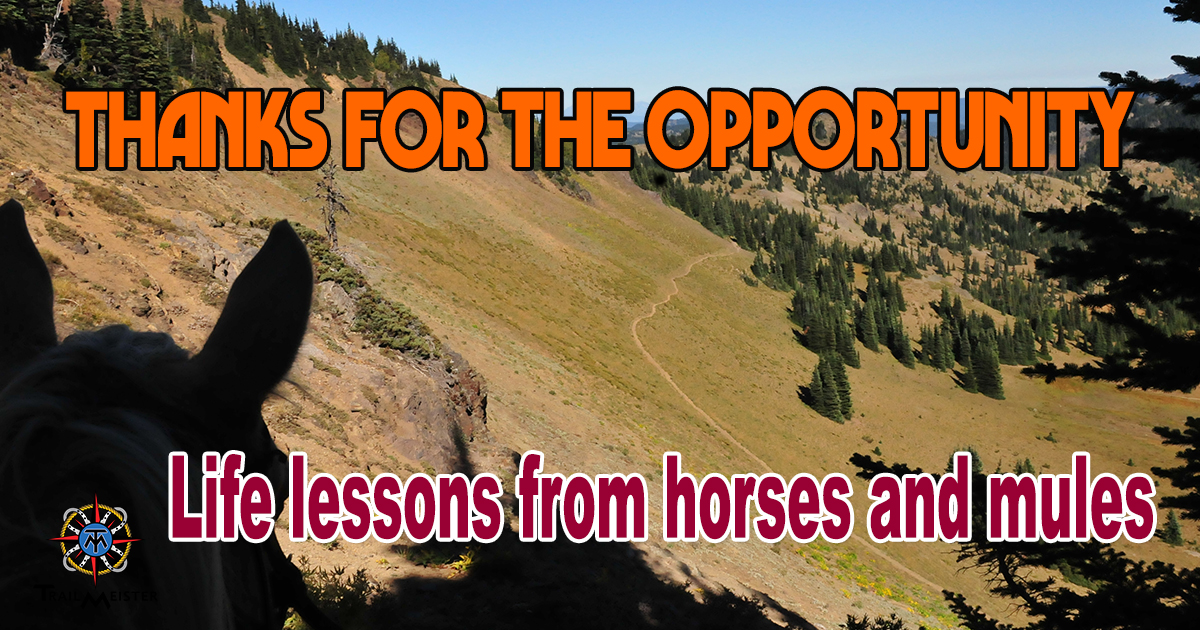
My friend Ty Evans, a wise muleman from Utah’s Intermountain West, has a more concise version: “Thank you for the opportunity.”
An eighth-century Buddhist scholar and a modern-day muleman might seem like an unlikely pair, but I think they’re circling the same idea. Things are going to go wrong. Sometimes we can fix them and sometimes we can’t. Either way, we get to decide what we’re going to do next.
When the Tools Don’t Arrive
I had a chance to put that idea into practice recently at a cinch-making clinic in Jamestown, Tennessee. I’d shipped several boxes of tools, looms, and materials from Spokane ahead of the class. Most of them arrived. Unfortunately, one box containing a good portion of the tools we needed did not.
I freely admit that my first thought was not “Thank you for the opportunity.” I panicked a little as I considered how we were going to make this work. The box of tools wasn’t there, but the class was, and we had cinches to make. And make them we did.
Everyone banded together. We shared tools, helped our neighbors, and worked in teams to solve problems as they came up. Instead of everyone concentrating solely on their own project, people paid attention to what the person beside them was doing and helped where they could.
The interesting part is that the arrangement worked very well. So well, in fact, that I may deliberately incorporate more of that team approach into future clinics. What started as a problem forced me to try something that I probably wouldn’t have considered otherwise.
That wayward box gave me a few anxious moments, but it also showed me a different and perhaps better way to teach a clinic. Had everything gone according to plan, I would have taught the class exactly as I always have and never discovered it.
Some Opportunities Are Harder
Of course, a missing parcel is a fairly easy opportunity to appreciate in hindsight. Some are harder.
This summer my doctor told me that riding was off the table for a while. For someone whose work, recreation, and a fair portion of his identity involve throwing a leg over a mule and heading down a trail, that wasn’t welcome news. I could remedy some parts of the situation, but I couldn’t change the part that mattered most to me. I wasn’t going riding. So where was the opportunity?
In my case, I spent more time on other things that too often get pushed aside when a mule is waiting at the gate. I worked on a new book about horse trailer safety. I taught clinics. And I spent more time making things with my hands in the shop. None of those things replaced riding, and I won’t pretend that they did. Given the choice, I would still have preferred to spend the summer in the high country, looking at the world between a pair of long ears.
But I wasn’t given that choice. I was given a different one: spend the summer dwelling on what I couldn’t do or find something worthwhile that I could.
Lessons from Horses and Mules
Our horses and mules give us plenty of smaller opportunities to practice the same thing. The mule that refuses to load may be pointing out a hole in our training. A flat tire may remind us that owning a trailer also means knowing how to change it safely. A camping trip that doesn’t go according to plan may expose something we should have packed, practiced, or learned before leaving home.
I don’t think this means that everything happens for a reason, and I certainly don’t believe we have to be cheerful when something goes sideways. Sometimes a problem is simply a problem, and being irritated about it for a bit seems reasonable to me. What matters is what comes afterward.
Lessons from Horses and Mules
Can I fix it? Then I’d better get busy. If I can’t fix it, can I learn something from it, change how I do things, or find another direction to travel?
I suspect Shantideva and Ty would both approve.
Thank you for the opportunity.
For more information on trail riding and horse camping, along with the world’s largest guide to places to ride and camp with horses, visit TrailMeister.com. Robert’s four books, covering everything from trail riding and camping to cinch making, thoughts from the saddle, and trailer safety, are also available on Amazon.