

Learning to Read the Gauges
Temperature, pulse, and respiration are the warning lights your horse can’t speak aloud.
I spend a fair amount of time teaching safety clinics, and one of the things we discuss is paying attention to our vehicles. We look at our truck gauges almost without thinking. Fuel level. Oil pressure. Engine temperature. If the temperature gauge pegs itself in the red, we don’t keep driving and hope for the best. If the oil pressure needle drops to zero, we don’t shrug and say, “It’ll work itself out.” We pay attention because we know the gauges are telling us something. They provide information that allows us to make decisions before a small problem becomes a big one.
The challenge with horses and mules is that they don’t come with dashboards.
Our critters don’t have gauges or check-engine lights mounted between their ears. No warning messages flash to let us know something is wrong. Instead, equines communicate through changes in behavior and their equine vital signs. That’s why I think every horse owner should know how to take a horse’s temperature, pulse, and respiration, and have at least a basic understanding of gum color, capillary refill time, and gut sounds. Those measurements are the closest thing our horses have to engine gauges. Temperature can indicate infection or heat stress. Pulse often rises with pain or dehydration. Respirations can increase with heat, discomfort, or respiratory problems.
I often hand out a small flyer during clinics with three columns. The first lists generally accepted normal values. The second is where owners write down their horse’s baseline numbers. The third is for the day something feels off. It isn’t fancy, just a few numbers and empty boxes, but I think it may be one of the more useful things I hand out.
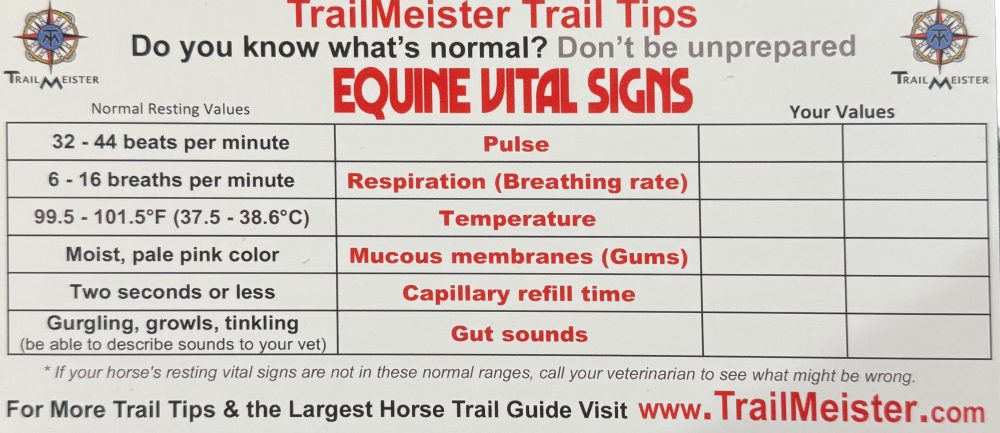
You can’t recognize abnormal if you’ve never taken the time to understand what normal looks like for your horse. A pulse of forty beats per minute might be perfectly normal for one horse and a reason for concern in another that normally rests in the low thirties. Every horse is an individual. “Normal” and “my horse’s normal” are not always the same thing.
I encourage people to fill in that second column while their horse is healthy and relaxed. Take a few minutes on a quiet evening. Listen to gut sounds. Count respirations. Take a temperature. Feel for a pulse. Do it more than once. Over time, you’ll develop a picture of what normal looks like for your horse.
Often, the first sign that something is wrong isn’t a number at all. Maybe your horse quits eating or simply seems off. That’s the moment to start checking your gauges. A horse with colic, heat stress, or illness can show changes in vital signs before the situation becomes obvious. Elevated pulse. Increased respirations. Reduced gut sounds. Changes in gum color. Those are your warning lights coming on.
The information also helps your veterinarian. There’s a big difference between saying, “Ruger doesn’t seem right,” and saying, “His normal pulse is around thirty-six, and right now it’s sixty. His respirations are elevated, his gums are tacky, and I can barely hear any gut sounds.” One statement voices concern. The other provides information. That information helps your veterinarian begin building a picture of what may be happening before they leave the clinic.
This becomes especially important for those of us who ride and camp in remote places. Many of our favorite trailheads are a long way from a veterinarian’s office. Sometimes help is far away and, at least for a little while, you’re the only person available to evaluate the situation. Knowing how to check vital signs won’t make you a veterinarian, but it will make you better prepared.
I think every horse and mule owner should ask their veterinarian to show them how to take equine vital signs. Most veterinarians are happy to spend a few minutes showing owners where to feel for a pulse, how to safely take a temperature, and how to count respirations. Those few minutes of instruction can pay dividends later. The first time you try to locate a pulse shouldn’t be while your horse is in pain at three in the morning.
You’re not trying to become a veterinarian. You’re simply learning to read the gauges. Numbers have a way of slowing us down. Instead of feeling helpless, you’re gathering useful information. Our trucks come with dashboards. Our horses don’t. Learning your horse’s equine vital signs is how we build one of our own.
For more thoughts on trail riding, horse camping, emergency preparedness, and caring for the horses and mules that carry us into wild places, visit me at www.TrailMeister.com, home to the world’s largest guide to horse trails and camps. You can also find my books, including The ABCs of Trail Riding and Horse Camping and Daily Wisdom from the Saddle, and It’s a Cinch! on Amazon
.