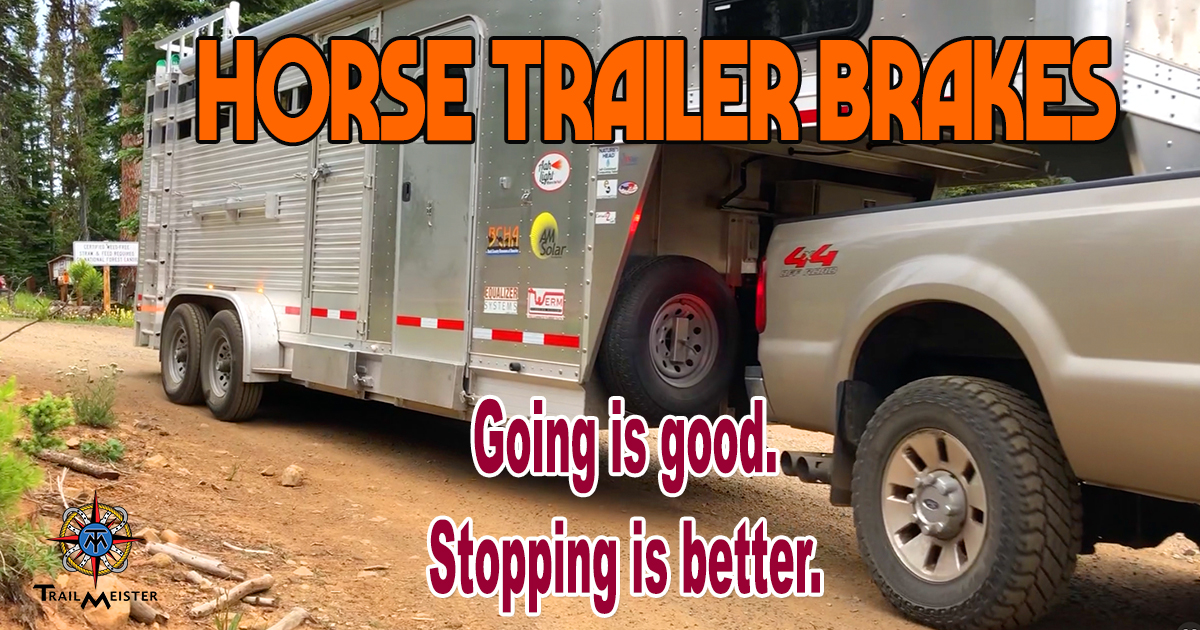
Going is good.
Stopping is better.
Trailer brakes are required by law in most states. They should be required everywhere, regardless of trailer size or how many horses you haul. This isn’t about bureaucracy. It’s about physics, animal welfare, and avoiding wrecks that never needed to happen.
A loaded horse trailer carries real momentum. When trailer brakes don’t work, the truck may slow while the trailer keeps pushing. Stopping distances increase. Truck brakes overheat. Ordinary traffic situations turn into emergencies. Jackknifing and runaway trailers often start there.
Inside the trailer, the truth is harder. Sudden or uneven braking throws animals off balance. They scramble, they slip, and they brace themselves against partitions that were never meant to hold that kind of force. Over time, horses learn to dread the trailer. Smooth, predictable braking isn’t just a safety concern. It’s good horsemanship.
Most modern horse trailers come with brakes already installed. Having them isn’t enough. You need to understand what type you have, how it works, and how to keep it working.
The 3 trailer brake systems you’ll see most
1) Electric trailer brakes (most common in the U.S.)
Electric brakes are the most common braking system on horse trailers in the United States. When they’re set up correctly, they offer reliable control and consistent stopping power.
Electric brakes use electromagnets inside the brake drums. A brake controller in the cab regulates how much current is sent to those magnets when you apply the brakes. The harder you stop, the more braking force the trailer receives.
Their greatest strength is control. Most brake controllers allow the driver to apply trailer brakes without touching the truck brakes. That matters when a trailer starts to sway in high winds or on long downhill grades.
Not all brake controllers behave the same. Proportional controllers respond to how quickly the truck slows, producing smoother stops than time-delay models. Regardless of style, the controller must be adjusted for the load. Settings that work for an empty trailer often fall short once the horses are on board.
True takeaway: If you tow with electric brakes, your brake controller is part of your horsemanship toolkit.
2) Hydraulic surge brakes (common in Europe, boats)
Hydraulic surge brakes work by using the trailer’s own momentum. When the tow vehicle slows, the trailer pushes forward against the hitch, compressing a hydraulic cylinder that applies the brakes.
When properly adjusted, surge brakes are smooth and simple. They don’t require a brake controller, which appeals to some setups. While less common in the United States, they’re widely used on European horse trailers and boat trailers.
Their weakness is control. Surge brakes can’t be applied independently. If a trailer begins to sway, the driver has no way to manually engage braking to help correct it. In mountainous areas, that limitation matters.
True takeaway: Surge brakes can be smooth, but they don’t give you the same options when things get sporty.
3) Emergency breakaway brakes (your last line of defense)
Breakaway brakes are not accessories. They are a last line of defense.
A breakaway system uses a small, independent battery mounted on the trailer. A cable connects the trailer to the tow vehicle, separate from the safety chains. If the trailer becomes uncoupled, the cable pulls a pin and activates full braking power.
The goal is simple: stop the trailer before it becomes a projectile. That system only works if it’s maintained. Batteries fail. Cables break. Testing matters.
True takeaway: A breakaway system is like a fire extinguisher—worthless if it doesn’t work the day you need it.
Maintenance and reality (what actually fails)
Trailer brakes don’t take care of themselves.
- Electric brakes need periodic adjustment as shoes wear.
- Magnets wear down.
- Wiring corrodes.
- An annual inspection is a reasonable minimum.
Load matters. A poorly balanced trailer won’t stop well, even with good brakes. Weight distribution, tongue weight, and axle configuration all play a role.
Heat matters too. Long downhill grades can cause brake fade in both truck and trailer. Downshifting and using engine braking reduce heat and keep brakes available when you need them.
Off pavement, braking changes again. Gravel, dirt, and wet surfaces reduce traction. Brake settings that work on asphalt can lock wheels on loose ground. Earlier, gentler braking is safer at trailheads and on forest roads.
Before you roll: a simple pre-trip brake checklist
Before every trip:
- Test trailer brakes at low speed.
- Confirm brake controller response.
- Check the breakaway cable and battery.
- Adjust settings for the load.
- Listen and feel for anything that isn’t right.
The bottom line
Trailer brakes make towing safer and calmer. They shorten stopping distances, protect tow vehicles, and they help horses arrive steadier and less stressed.
You can tow without trailer brakes—right up until the moment you can’t stop. That moment arrives fast and without warning.
Going is easy.
Stopping takes preparation.
Want more practical trail safety like this?
If you want trail maps, safety tips, and the largest horse-camping directory in the U.S., start here: TrailMeister.com.
- The ABCs of Trail Riding and Horse Camping
- It’s a Cinch!
- Daily Wisdom from the Saddle